Introduction
Varicose veins are a common problem that affects many people, often causing pain, heaviness, and visible bulging in the legs. While surgery used to be the only option for treating varicose veins, there are now many non-surgical treatment options available that are safer, less invasive, and require significantly less recovery time.
In this article, we explore some of the non-surgical treatment options for varicose veins, as explained by Dr. Shoaib Padaria, one of India's leading Vein Specialists and the Pioneer of Laser treatment in India. These modern approaches have transformed vein care, making effective treatment more accessible and comfortable than ever before.
Why Non-Surgical Options Have Become the Standard
Traditional vein stripping surgery involved significant incisions, general anesthesia, and a lengthy recovery period. Over the past two decades, advances in medical technology have shifted the standard of care toward minimally invasive procedures that achieve comparable, and often superior, results with a fraction of the downtime.
Today, most patients with varicose veins can be treated on an outpatient basis, often returning to normal activities within a day or two. This shift has made timely treatment far more accessible, removing many of the barriers—cost, recovery time, scarring—that once discouraged patients from seeking care early.
Compression Stockings
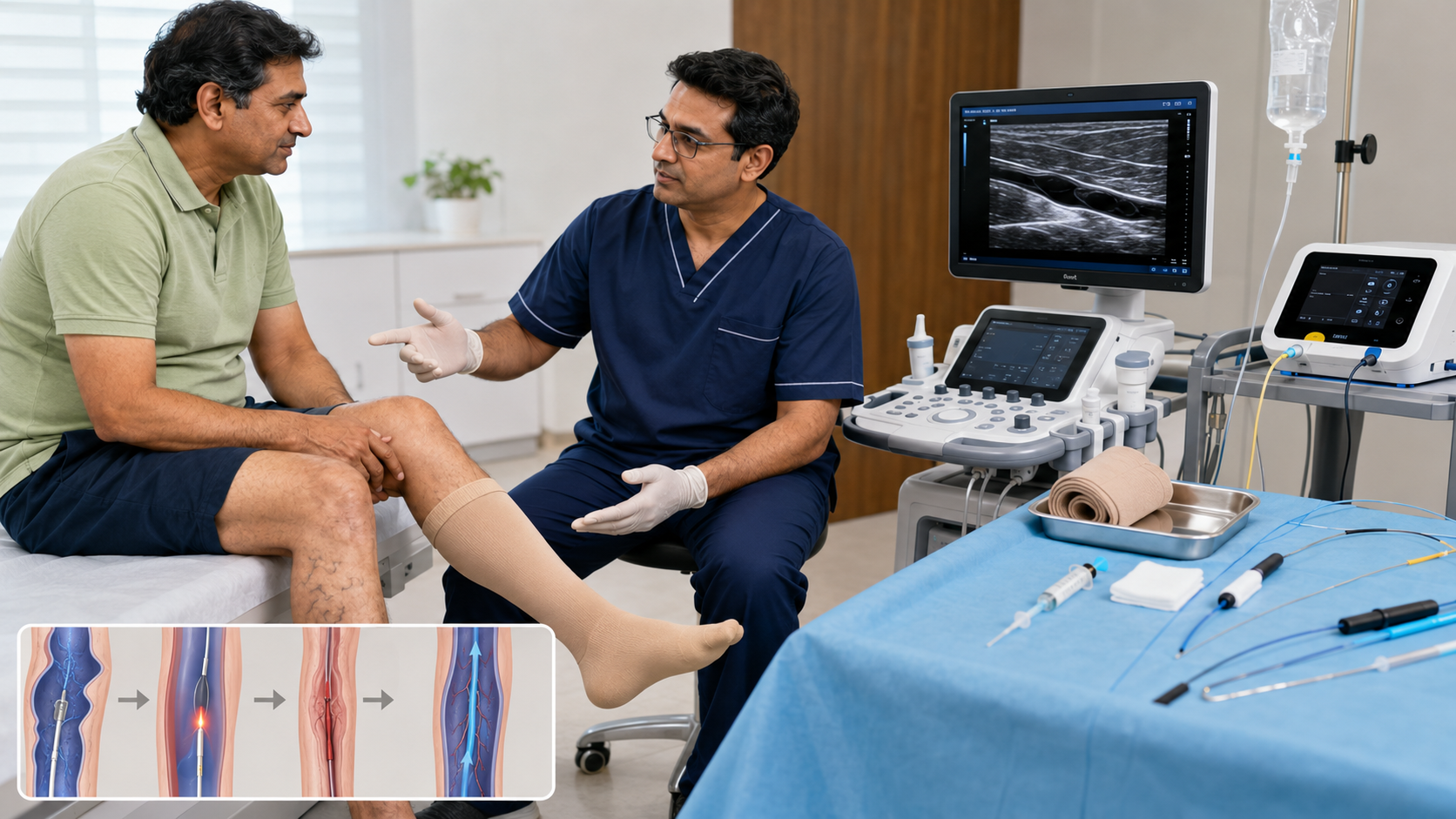
Compression stockings are a type of tight-fitting socks that help improve circulation in the legs. They work by applying pressure to the legs, which helps to reduce swelling and prevent blood from pooling in the veins.
Compression stockings are often the first line of treatment for varicose veins, and they can be purchased over-the-counter or prescribed by a doctor. While they don't eliminate existing varicose veins, they can meaningfully ease symptoms and are frequently recommended alongside other treatments, both before and after procedures.
Sclerotherapy
Sclerotherapy is a minimally invasive procedure that involves injecting a solution directly into the affected veins. The solution irritates the lining of the veins, causing them to collapse and stick together.
Over time, the veins turn into scar tissue and fade from view. Sclerotherapy is often used to treat small varicose veins and spider veins, and typically requires little to no downtime, with most patients resuming normal activities immediately after the procedure.
Radiofrequency Ablation (RFA)
Radiofrequency ablation (RFA) is a minimally invasive procedure that uses radiofrequency energy to heat and close off the affected veins. A thin catheter delivers targeted heat energy directly to the vein wall, causing it to collapse and seal shut.
The procedure is performed under local anaesthesia, and patients can usually return to normal activities within a day or two, making it a convenient option for those looking to minimize disruption to their daily routine.
Endovenous Laser Treatment (EVLT)
Endovenous laser treatment (EVLT) is a minimally invasive procedure that uses laser energy to heat and close off the affected veins. A thin laser fiber is inserted into the vein under ultrasound guidance, sealing it shut from within as it's gradually withdrawn.
The procedure is performed under local anaesthesia, and patients can usually return to normal activities within a day or two. Currently, it is the most effective treatment available for significant varicose veins, offering excellent long-term success rates with minimal scarring or discomfort.
Other Minimally Invasive Options
Beyond sclerotherapy, RFA, and EVLT, several other non-surgical treatments have emerged in recent years to give patients and specialists more choices depending on vein size, depth, and location. Glue therapy uses a medical adhesive to seal the affected vein shut, while MOCA (Mechanochemical Ablation) combines mechanical irritation with a sclerosant solution to close the vein without heat.
Microwave laser therapy, High Intensity Focused Ultrasound (HIFU), and steam ablation represent further advances in energy-based vein closure, each offering slightly different benefits depending on the patient's specific condition and anatomy.
Lifestyle Changes
Making lifestyle changes can also help improve symptoms of varicose veins, whether used on their own for mild cases or alongside a medical procedure for more advanced ones. Some lifestyle changes that can be helpful include exercising regularly, maintaining a healthy weight, avoiding standing or sitting for long periods of time, and elevating your legs whenever possible.
While lifestyle changes alone can't eliminate existing varicose veins, they play an important supporting role in managing symptoms and reducing the likelihood of new veins developing over time.
Choosing the Right Treatment for You
With so many non-surgical options now available, the best treatment often depends on factors such as the size and depth of the affected veins, overall symptom severity, and individual patient preferences. A thorough evaluation, typically including a Doppler ultrasound, allows a vein specialist to recommend the most suitable approach.
Many patients benefit from a combination of treatments—for example, EVLT or RFA to close a larger underlying vein, paired with sclerotherapy to address smaller surface veins—tailored to achieve the best possible cosmetic and clinical outcome.
Conclusion
In conclusion, there are many non-surgical treatment options available for varicose veins. Compression stockings, sclerotherapy, RFA, EVLT, and lifestyle changes can all be effective in improving symptoms and preventing complications.
If you're experiencing symptoms of varicose veins, it's important to talk to a Vein Specialist like Dr. Shoaib Padaria to determine the best treatment plan for you. With the right treatment, you can improve your symptoms and prevent complications.